

Tourism has a credibility problem in economic development circles. It gets treated as a consolation prize. It is something you pursue while you’re waiting for a real industry to show up. That framing is increasingly out of step with what the data shows.
In communities with strong natural or cultural assets, tourism is not a placeholder strategy. It’s a primary economic driver. And in rural communities navigating industrial transition, it’s often the fastest path to near-term job creation and local revenue growth.
A recent industry diversification study of six Southern West Virginia counties makes this case with concrete numbers. Here’s what the analysis found, and what it means for EDOs thinking through their own tourism potential.
Start With the Numbers
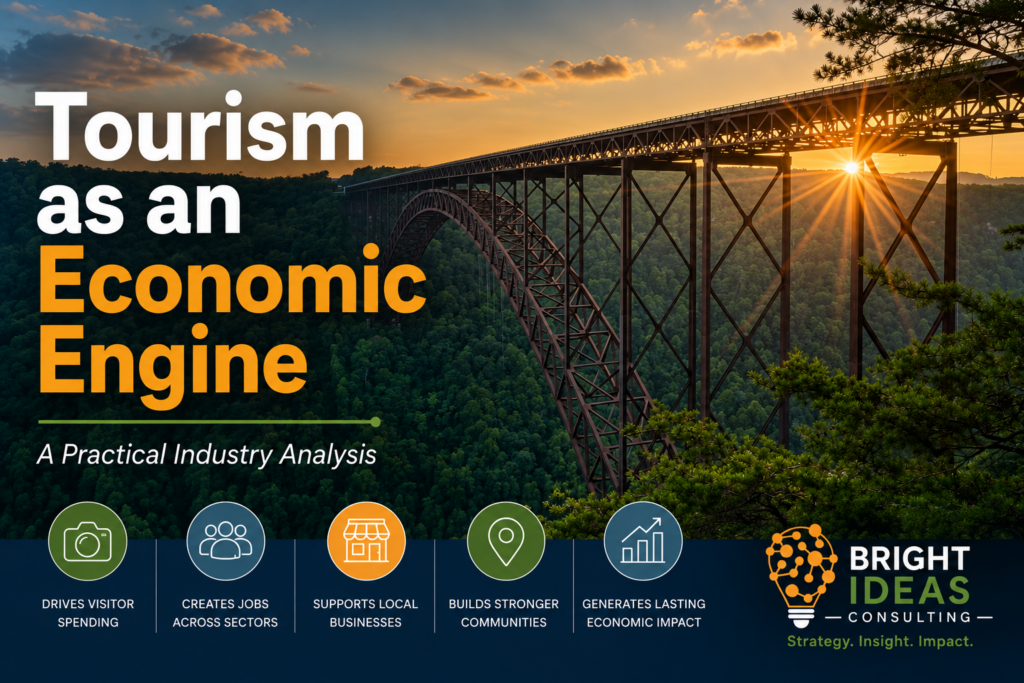
New River Gorge became West Virginia’s first National Park in 2021. In 2024, it drew 2,080,330 visitors who spent $108.4 million in surrounding counties. This was a 12 percent increase over 2023. That’s not a projection, that’s documented, growing demand landing in communities that are still building the infrastructure to fully receive it.
Statewide, West Virginia projects 21,000 annual tourism job openings through 2030. Ten thousand of those are management positions averaging $60,000 a year. For context: healthcare, the dominant employer across the six-county study area, pays median earnings of $32,000 to $42,000. Tourism management, done right, closes a meaningful portion of the wage gap that industrial decline created.
The takeaway for EDOs is simple: in communities adjacent to major natural or cultural assets, tourism revenue isn’t speculative. It’s a market already in motion. The question is whether your community is positioned to capture its share, or whether visitor spending flows out to regional hotels and dining chains somewhere else.
One Region, Several Different Tourism Products
One of the most useful things the diversification study does is break tourism down by product type. This matters because different tourism products attract different visitors, serve different community strengths, and require different infrastructure investments. Southern West Virginia illustrates the range.
Outdoor Recreation
This is the anchor. Raleigh and Summers counties lead with whitewater, climbing, and trail systems tied to the New River Gorge. ATV trail networks are developing across multiple counties. A new mountain coaster recently opened in Princeton, a more accessible outdoor draw for families and casual visitors. The WVU Outdoor Economic Development Collaborative’s CORE Initiative, backed by a $1.2 million ARC POWER grant, is actively expanding mountain biking infrastructure across the region. Trail development is consistently the highest-return investment for outdoor tourism communities.
Heritage Tourism
Draws a different visitor, typically older, longer-staying, and higher-spending per trip. The coalfield heritage sites of McDowell and Wyoming counties tell a nationally significant story of industrial history and labor struggle. Monroe County, largely bypassed by the railroads that industrialized its neighbors, carries a different kind of history: in the antebellum era, its mineral spring resorts drew Presidents Monroe, Madison, and Van Buren. That’s a heritage asset most communities would envy. Heritage tourism and outdoor recreation aren’t competing products. They serve different audiences and extend the season for local businesses.
Agritourism
A newer but growing segment of tourism. Monroe County’s agricultural character and proximity to the Greenbrier Valley make it a natural fit for farm stays and specialty produce experiences. In McDowell County, community groups are developing farming programs on reclaimed mine lands, growing berries, and planting orchards. Visitors are already showing up to see it. Agritourism adds economic value to agricultural production while extending the visitor economy into communities that don’t have traditional outdoor recreation anchors.
The Lodging Problem
If there’s one constraint the diversification study keeps returning to, it’s lodging. Visitor growth around New River Gorge has outpaced the supply of quality places to stay. When visitors can’t find accommodations, they don’t stay longer. They drive to the next town, and their food, fuel, and retail spending goes with them.
Short-term rentals have helped, but they’re not a complete solution. In parts of the region, the housing stock is in poor condition, and rising home prices have made renovation-to-rental less financially attractive. McDowell County has a housing occupancy rate of just 69 percent, meaning nearly a third of units sit vacant. The condition of that stock is a real barrier to rapid conversion.
The more strategic answer is downtown redevelopment. Upper-story lodging and residential above ground-floor commercial creates the density and streetscape that keeps visitors in town spending. It also addresses workforce housing needs at the same time. Communities in Hinton and Princeton are already seeing results from this approach. Bluefield and Mullens are beginning to follow. For EDOs, framing is important: downtown redevelopment is not just a beautification project. It’s a tourism infrastructure investment.
Don’t Forget Maintenance
Trail systems and recreation facilities can be built with grants and public dollars. Keeping them open and safe is a different problem. One that most funding programs don’t cover.
The study points to a practical and underused solution: Scouting America operates a high-adventure facility in the region and regularly brings groups seeking service projects. Building a formal mechanism for service groups to adopt trail segments or take on maintenance days creates a volunteer pipeline that doesn’t depend on annual appropriations.
There’s also a revenue angle. The facility hosts national and international events. This extends not only opportunities to provide services to those traveling, but also to provide essential services to a large number of customers. If developed properly, the facility’s services and needs can be met by local businesses, rather than by businesses that currently go out of state for resources.
Regional Coordination Is the Multiplier
Individual county tourism efforts can build audiences, but they rarely build the kind of destination identity that drives overnight stays and extended itineraries. The diversification study’s long-term vision is an interconnected tourism economy spanning all six counties. Coordinated trail systems, a diverse lodging supply, and community-based services that give visitors reasons to stay longer and spend more.
The near-term benchmark is $150 million in annual visitor spending by 2028, up from $108.4 million in 2024. Getting there requires moving from individual county marketing to unified regional positioning. Visitors don’t experience county lines. Your marketing shouldn’t either. County tourism boards, the study notes, are often the leading economic development partners in rural communities and they’re a valuable source of intelligence about service gaps and unmet visitor needs. Connecting them into a regional network isn’t just a branding exercise. It changes how resources are deployed and how the overall product is presented.
Four Things to Do Right Now
- Know your product. Outdoor recreation, heritage tourism, and agritourism are different markets. Identify which fits your community’s assets and build your strategy around that fit.
- Close the lodging gap. Prioritize downtown redevelopment and short-term lodging expansion as economic infrastructure, not cosmetic improvement.
- Build a maintenance plan. Don’t wait until your trails are degraded to figure out who’s responsible for keeping them open.
- Coordinate regionally. The communities that position themselves as part of a larger destination attract longer stays and higher spending than those competing in isolation.
Tourism won’t replace every industrial job a community has lost. But managed strategically, it creates employment, anchors downtown investment, supports small business growth, and makes a community more attractive to residents and investors in every other sector. That’s what a genuine economic engine looks like.